Where exactly do you measure hips?
Your hip measurement is taken around the widest point of your glutes — the fullest part of your buttocks when viewed from the side. It is not taken at the hip bones, which sit several inches higher and give a noticeably smaller number.
If you're unsure, stand sideways to a mirror and slide the tape up and down until you find the largest circumference. That's your landmark — and, as with every measurement, using the same spot every time matters more than the spot itself.
Step-by-step: measuring your hips
- Undress to bare skin or thin, non-bulky underwear. Pockets, seams and waistbands all add noise.
- Stand with your feet together, weight even on both legs. A wide stance flattens the glutes and changes the reading.
- Wrap the tape around the widest point of your glutes, level with the floor all the way around.
- Check the tape in a mirror — side-on if you can. The tape loves to dip at the back, and a dipping tape reads short.
- Keep it snug, not tight. The tape should lie flat on the skin without pressing into it.
- Read where the tape overlaps and log it immediately.
The 3 mistakes that skew hip measurements
- Measuring at the hip bones. The word "hips" misleads — the bony points are the wrong landmark. Go lower, to the widest point of the glutes.
- Tape dipping at the back. You can't see behind you, so the tape sags below the fullest point and reads short. Use a mirror, or measure side-on to one.
- Changing your stance. Feet apart one week, together the next — the glutes change shape and so does the number. Feet together, every time.
Waist-to-hip ratio: the number your hips unlock
Divide your waist measurement by your hip measurement — same units — and you get your waist-to-hip ratio (WHR). Example: a 30-inch waist over 40-inch hips is a WHR of 0.75.
As general guidance, the World Health Organization associates increased metabolic risk with a WHR above roughly 0.90 for men and 0.85 for women. Like all such thresholds it varies with build and ethnicity, so treat it as a reference — and, as always, watch the direction of the trend rather than obsessing over one reading. To get the waist half right, see our guide on how to measure your waist.
Why hips matter for fat-loss tracking
For many people — especially women — the hips and thighs are where fat is stored first and lost last. That makes hip circumference a slow but honest signal: when it moves, real change is happening. It's also a measurement the scale completely hides. During body recomposition, your weight can hold steady for weeks while your hip measurement quietly drops — one of the clearest cases of losing inches but not weight.
Watch your hip trend, not one number 📉
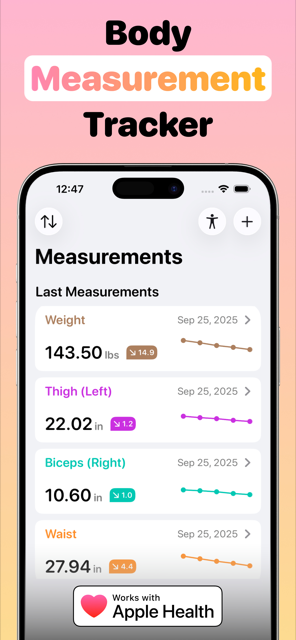
A single hip measurement tells you little — the trend over months tells the real story. In the Body Measurement Tracker app, your hips get their own dashboard tile with a 30-day trend and delta badge, plus an interactive chart across months or years. Built-in how-to-measure instructions keep your landmark consistent, and a weekly reminder makes sure measurement day actually happens.


How often should you measure your hips?
Once a week, same day and same conditions, is plenty. Hip circumference moves slowly, so weekly points give you a clean line without daily water-weight noise. Pair it with your waist each week and your waist-to-hip ratio tracks itself. For the full technique across every body part, start with how to take body measurements.