Where exactly do you measure your biceps?
At the largest point of your upper arm — the peak of the biceps, roughly midway between the tip of your shoulder and your elbow. You're measuring the full circumference of the upper arm (biceps and triceps together), and the widest point is the landmark you can find again next month.
The tape should run perpendicular to the upper arm, flat against the skin all the way around. A tape that spirals even slightly reads long.
Flexed or relaxed? Pick one — and never switch
There are two valid conventions for measuring arms:
- Relaxed: arm hanging loose at your side, muscle completely soft.
- Flexed: arm raised to shoulder height, elbow bent at 90°, biceps squeezed hard.
A flexed arm typically measures about an inch larger than a relaxed one, so the two numbers are not interchangeable. This guide recommends the flexed 90° position — it's the convention most lifters use, and a hard flex is easier to reproduce exactly than "relaxed," which quietly turns into a half-flex when nobody's watching. Whichever you choose, write it down and use it forever.
Step-by-step: measuring your bicep size
- Measure on bare skin — sleeves add noise.
- Raise your arm to shoulder height and bend the elbow to 90°, in front of a mirror.
- Flex hard and hold the flex steady while you measure.
- Wrap the tape around the largest point of the upper arm, perpendicular to the arm, snug but not digging into the muscle.
- Read the tape where it overlaps and note the number to the nearest eighth of an inch (or millimeter).
- Repeat on the other arm, then log both numbers immediately.
The 4 mistakes that ruin arm measurements
- Switching between flexed and relaxed. The two differ by around an inch, so mixing them makes your chart meaningless.
- Measuring after training. The pump is temporary. Comparing a pumped arm to a cold one manufactures fake progress — or fake regression.
- A spiraling tape. The tape must sit perpendicular to the upper arm; even a slight diagonal adds length.
- Pulling the tape tight. Compressing the muscle shaves off real size and is impossible to repeat with the same pressure. Snug and flat, every time.
Measure both arms — asymmetry is normal
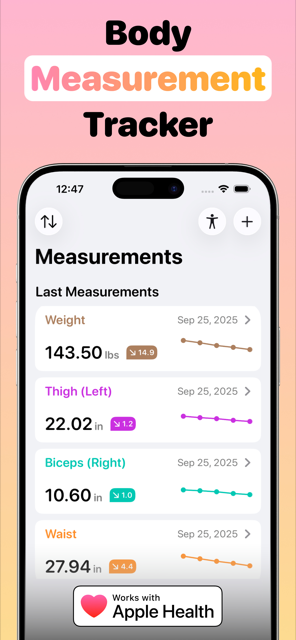
Almost nobody's arms match. A difference of a quarter to half an inch between your dominant and non-dominant arm is completely normal — and worth tracking, because it tells you whether the gap is closing as you train. That's why the Body Measurement Tracker app tracks Biceps Left and Biceps Right as two separate trackers, each with its own chart and trend, instead of forcing one blended number.
What's an average bicep size?
As a general reference only: surveys of adults put average relaxed upper-arm circumference somewhere around 13–14 inches (33–36 cm) for men and 12–13 inches (30–33 cm) for women, varying widely with height, body weight and body fat. Averages say very little about you — a lean 12-inch arm and a soft 15-inch arm are different stories. The number that matters is your own trend: is the tape reading more than it did eight weeks ago, under the same conditions?
Track both arms, see the trend 💪
In the Body Measurement Tracker app, Biceps Left and Biceps Right are separate trackers — log both in seconds and get a 30-day trend, an all-time delta and an interactive chart for each arm. Set a goal arm size and watch the line climb, and let the weekly reminder keep your measuring day consistent.


How often should you measure your arms?
Every 2–4 weeks is plenty. Muscle grows slowly — measuring daily just charts water, food and pump. Monthly points under identical conditions produce a chart that actually shows growth. For the full reasoning, see how often to take body measurements, and if arm size is part of a bigger goal, read how to track muscle growth.