Reason 1: body recomposition — losing fat while gaining muscle
If you're strength training and eating reasonably, your body can do two things at once: burn fat and build muscle. Muscle is significantly denser than fat — a pound of muscle takes up roughly 20% less space than a pound of fat. So when you trade one for the other, the scale sees a wash, but the tape measure sees a smaller waist, tighter hips and firmer arms.
This is called body recomposition, and it's especially common in beginners, people returning to the gym after a break, and anyone who recently increased their protein intake. It's not a plateau. It's the most efficient kind of progress you can make — you're literally getting leaner and stronger at the same time, and only your measurements can prove it.
Reason 2: water retention is hiding your fat loss
Even when you are losing pure fat, the scale can refuse to show it for days or weeks. Your body's water weight swings by several pounds based on:
- Salt — one restaurant meal can add 2–3 lbs of water overnight.
- Stress — elevated cortisol promotes water retention.
- Your menstrual cycle — fluctuations of 3–5 lbs across the month are normal.
- New or harder training — muscles hold extra water while they repair, which is why starting a program often makes the scale go up first.
Fat loss underneath all that water noise is invisible on the scale — but a shrinking waist circumference cuts straight through it.
Reason 3: scale weight is the noisiest metric you can track
Your weight isn't one number — it's fat, muscle, bone, water, glycogen, and whatever you ate and drank in the last 24 hours, all summed together. Weigh yourself three times in a day and you can get three answers spanning 4 lbs. Judging a fat-loss phase by daily scale weight is like judging a road trip by watching the speedometer needle vibrate.
Measurements are different. Your waist doesn't care about last night's pasta the way the scale does, and week over week it moves in one direction when you're genuinely losing fat. That's why the question "why is my weight not changing but I look slimmer?" almost always has the same answer: you're measuring the wrong thing.
This is a win — not a plateau
Losing inches at a stable weight means your body composition is improving: less fat, same or more muscle. That combination is associated with better strength, better metabolic health markers, and the visual changes people actually want. If your goal was ever "look better and feel better," you're getting exactly that — the scale just isn't equipped to report it.
What to do next
- Keep strength training — it's the stimulus that tells your body to hold onto muscle while fat comes off.
- Keep protein high — it supports muscle retention and recovery.
- Judge progress by measurements, photos and how clothes fit — the three signals that track fat, not water.
- Weigh yourself less often, or only look at the multi-week trend and ignore individual readings entirely.
The scale can't see it. The tape can. 📉
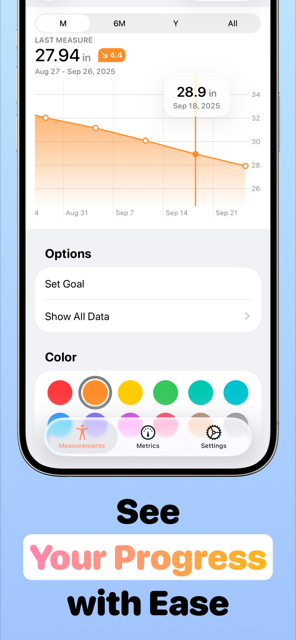
If you're losing inches but not weight, the fix isn't a new diet — it's tracking the right numbers. The Body Measurement Tracker app logs your waist, hips, chest and more in seconds, then shows you the 30-day trend, the all-time change and a chart of every measurement. The proof that you're making progress is already on your body — the app just makes it visible. Free on iPhone and Android.


When should you actually worry?
Only when everything stalls. If your measurements, progress photos and clothes have all been unchanged for 3–4 weeks, that's a real plateau, and it's worth reviewing calories, protein and training volume. But if the inches are still coming off? Nothing is wrong. Keep going — and let the tape, not the scale, tell the story. (Not sure your technique is consistent? Start with how to measure your waist correctly.)