What is BMI, exactly?
Body Mass Index is your weight in kilograms divided by your height in meters, squared (kg ÷ m²). Someone who is 1.75 m tall and weighs 70 kg has a BMI of 70 ÷ (1.75 × 1.75) = 22.9. Working in pounds and inches? The formula is (weight × 703) ÷ height in inches². It's a screening number, invented to compare populations — which explains both its usefulness and its blind spots.
The standard BMI categories
The World Health Organization's general guidance for adults groups BMI into four ranges:
- Below 18.5 — underweight
- 18.5 – 24.9 — normal range
- 25 – 29.9 — overweight
- 30 and above — obese
Treat these as population-level reference points, not a verdict. Healthy ranges shift with age, build, and ethnicity (some health bodies use lower cutoffs for certain populations), and none of this replaces advice from a healthcare professional who can see the whole picture.
BMI's known limits — and how to work around them
BMI has one big blind spot: it can't tell muscle from fat. It only knows your total weight. A lean, muscular lifter and a sedentary person of the same height and weight get the exact same BMI — which is why plenty of athletes score "overweight" while carrying very little fat.
The fix isn't to throw BMI away; it's to pair it with waist circumference. Your waist responds to fat, not muscle, so the combination separates the scenarios BMI alone can't: a BMI of 27 with a shrinking waist usually means muscle gain; a BMI of 27 with a growing waist points the other way. (Get the tape placement right with our waist measurement guide.)
Why the trend beats a single reading
A one-off BMI reading inherits all the noise of a one-off weigh-in — water, salt, yesterday's dinner. But tracked weekly over months, BMI becomes a clean, height-normalized view of your weight trajectory: is it drifting up, holding steady, or coming down toward your target range? The direction and rate of change are far more actionable than whether today's number is 24.8 or 25.1. Crossing a category line after months of consistent movement means something; bouncing across it day to day means nothing.
How to track BMI in the app
In the Body Measurement Tracker app, BMI tracking is fully automatic:
- Enter your height once in Settings.
- Log your weight whenever you weigh in — that's it.
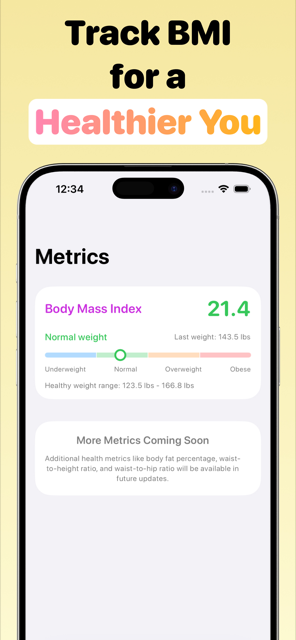
- Open the Metrics tab: every weight entry updates your BMI, shown on a category gauge (Underweight / Normal / Overweight / Obese) alongside your personal healthy weight range for your height.
No formulas, no conversion between units — the app handles imperial and metric either way.
Your BMI, computed on every weigh-in 📊
The Body Measurement Tracker app is a BMI tracker and a tape-measure log in one: your weight history drives an always-current BMI gauge with your healthy range, while waist, hips, chest and more fill in the story BMI can't see. More metrics — body fat %, waist-to-height and waist-to-hip ratios — are on the way. Free on iPhone and Android, and your data stays on your phone.


One more check worth knowing: waist-to-height ratio
A simple complementary rule of thumb is keeping your waist circumference under half your height — a check that catches abdominal fat that BMI can miss and forgives muscle mass that BMI penalizes. Between a weekly BMI trend, a waist measurement, and a full body measurement chart, you get a rounded picture of your progress — one no single number can give you. And if your BMI ever flatlines while your measurements keep improving, that's not a stall: read losing inches but not weight to see why.