Where exactly is "the waist"?
Your waist is the narrowest point of your torso — usually just above the belly button and below the rib cage. That's the landmark to use every single time.
Can't find an obvious narrow point? Use the midpoint between the bottom of your ribs and the top of your hip bones (this is the World Health Organization's standard site for waist circumference). What matters most is not which convention you choose, but that you use the same spot every time.
Step-by-step: measuring your waist
- Undress to bare skin (or one thin layer). Clothes add up to an inch of noise.
- Stand tall and relaxed in front of a mirror — the mirror helps you check the tape is level.
- Wrap a soft tape measure around your waist at your landmark, level with the floor all the way around. A tape that dips at the back reads short.
- Exhale normally, then read the tape. Don't suck in and don't push out. Measure at the end of a normal breath out.
- Keep the tape snug, not tight. It should sit flat on the skin without compressing it.
- Log the number immediately — before you forget it or round it in your favour.
The 4 mistakes that ruin waist measurements
- Sucking in. The most common one. You get a flattering number you can never reproduce.
- Different spot each time. An inch higher or lower on your torso can change the reading by two inches.
- Tape not level. Check it in a mirror — front and back at the same height.
- Measuring after meals or workouts. Food, water and muscle pump all inflate the number temporarily.
What's a healthy waist measurement?
As a general guide, health organisations flag increased metabolic risk above 40 in / 102 cm for men and 35 in / 88 cm for women. Thresholds vary by ethnicity and build, so treat them as a rough reference — and remember that the direction of your trend is more actionable than any single reading.
Track your waist trend automatically 📉
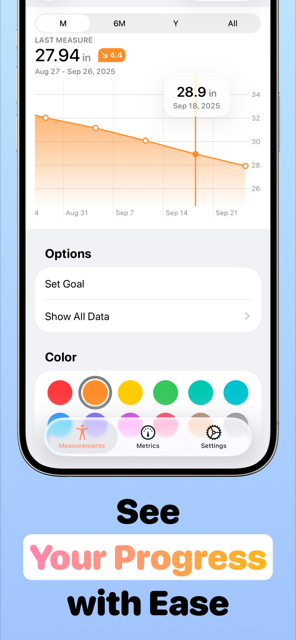
One measurement tells you little — the trend tells you everything. In the Body Measurement Tracker app, log your waist in seconds and get a 30-day trend, an all-time delta and an interactive chart. Set a goal waist size and watch the line close in. On iPhone, your waist circumference even syncs to Apple Health.


How often should you measure your waist?
Once a week is ideal for most goals. Fat loss shows up in waist circumference within 2–3 weeks of consistent effort, and weekly points make the chart meaningful without magnifying daily noise. The app's weekly reminder takes remembering off your plate — read the full guide on how often to take body measurements.