Why thigh measurements go wrong
Unlike your waist or biceps, a thigh has no single obvious widest point that's easy to find twice. Circumference varies enormously along the leg — from just below the glutes down to the knee, the tape can read several inches differently. Measure "somewhere on the upper thigh" and you're not tracking your body, you're tracking where the tape happened to land.
So for thighs more than any other measurement, the landmark matters most. Two conventions work:
- Just below the glute fold — the widest point of the upper thigh, right under where the glute meets the leg.
- A fixed distance above the kneecap — for example, 15 cm (about 6 in) above the top of the kneecap, measured with the same tape.
The glute-fold site is quicker; the fixed-distance site is the most reproducible if your body is changing shape. Pick one, note it down, and reuse it every single time. A measurement taken at a different spot isn't a data point — it's noise.
Step-by-step: taking your thigh measurement
- Measure on bare skin — leggings and jeans add real error on a thigh.
- Stand upright with your weight even on both feet, legs about hip-width apart, thigh muscle relaxed. Don't shift your weight onto the leg you're measuring.
- Find your landmark — the widest point below the glute fold, or your fixed distance above the kneecap.
- Wrap the tape around the thigh, level with the floor all the way around. Check in a mirror that it isn't dipping at the back.
- Keep the tape snug, not tight — flat on the skin without denting the muscle.
- Measure both legs and log both numbers immediately.
The 4 mistakes that ruin thigh measurements
- A different spot each time. The big one. On a thigh, an inch of tape drift can swamp months of real change.
- Shifting your weight onto one leg. A loaded thigh flexes and reads larger. Weight even on both feet, muscle soft.
- Measuring over clothes. Fabric bunches on the thigh more than anywhere else — bare skin only.
- Measuring after leg day or a long sit. Training pump and pooled fluid both inflate the number for hours.
Measure both legs — separately
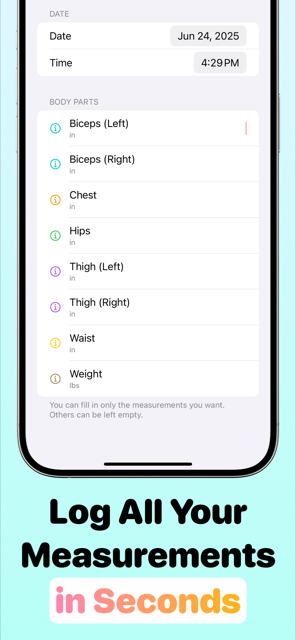
Almost everyone has a small difference between legs, especially if you play a one-sided sport or have an old injury. Tracking each leg on its own tells you whether that gap is closing. The Body Measurement Tracker app treats Thigh Left and Thigh Right as two separate trackers, each with its own chart, so a left-right imbalance is visible instead of averaged away.
What should the numbers do?
That depends on your goal. Building muscle? Expect slow increases — as general guidance, visible thigh growth takes months of consistent training, not weeks. Losing fat? Thighs often shrink later than the waist, so a flat thigh line while your waist drops is normal, not a failure. Either way, the trend across weeks is the signal; any single reading is mostly water, timing and tape placement.
Log both thighs in one entry 🦵
In the Body Measurement Tracker app, one logging form covers Thigh Left, Thigh Right and every other measurement you track — fill in only the fields you want. Each thigh gets its own 30-day trend, all-time delta and interactive chart, and you can set a goal per leg. A weekly reminder keeps your measuring day consistent.


How often should you measure your thighs?
Once a week to once every two weeks is plenty. Thigh circumference changes slowly, and daily measuring mostly charts fluid shifts. Weekly points taken under identical conditions — same morning, same landmark, same relaxed stance — build a chart you can trust.