Where exactly do you measure your chest?
Wrap the tape around the fullest part of your chest, across the nipple line, and across your back at the same height. That single landmark works for everyone — it's also where you'd take a bust measurement.
The chest is unusually sensitive to posture and breathing: puffed shoulders, a raised ribcage or a deep breath can each add an inch or two. The steps below neutralize all three.
Step-by-step: measuring your chest
- Undress to bare skin (or the same thin layer every time — see the bust note below).
- Stand tall in front of a mirror with your shoulders down and relaxed. No puffing, no slouching.
- Wrap the tape around the fullest part of your chest, across the nipple line, and check in the mirror that it crosses your back level with the floor — the tape loves to ride up between the shoulder blades.
- Let your arms hang relaxed at your sides. Raised arms stretch the chest and change the reading; hold the tape ends in front of you with your elbows low.
- Exhale normally, then read the tape at the end of the breath out. A full inhale can inflate chest circumference by two inches.
- Keep the tape snug, not tight, and log the number immediately.
Flexed or relaxed? Pick one and never switch
Lifters love to measure flexed — chest spread, lats engaged — and there's nothing wrong with that, as long as you understand the trade-off. A flexed measurement is harder to reproduce: your "flex" varies with fatigue, practice and enthusiasm, and that variation looks exactly like progress (or regress) on a chart.
Relaxed is the standard convention and the easier one to keep honest. If you prefer flexed, commit: same pose, same breath, same effort every time — and never compare a flexed number to a relaxed one. Mixing the two is the fastest way to make months of chest data worthless.
Why chest matters for muscle-gain tracking
If you're training for size, chest circumference is one of your best progress markers. The chest wraps some of the largest muscles you can grow — pecs and lats both live under the tape — so a bulking or recomposition phase shows up here in a way a scale simply can't isolate. A rising chest measurement alongside a steady waist is about the clearest evidence of lean gain you can get with a $3 tool. Pair it with your arms — see how to measure your biceps — for the full upper-body picture, and read how to track muscle growth for what realistic month-to-month change looks like.
The 3 mistakes that ruin chest measurements
- Measuring on the inhale. The big one. Always read at the end of a normal exhale.
- Tape riding up at the back. Check the mirror — the tape should cross your back at nipple-line height, not up between the shoulder blades.
- Silently switching between flexed and relaxed. One convention, forever.
Chart your chest gains over months 📈
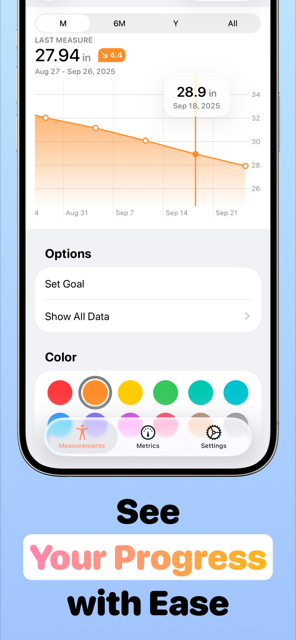
Muscle growth is slow — a quarter inch a month is a great result — so the trend matters far more than any single reading. In the Body Measurement Tracker app, every chest entry lands on an interactive chart with 30-day and all-time trends, and you can set a goal chest size and watch the line climb toward it. Built-in step-by-step measuring instructions keep your technique identical week after week.


How often should you measure your chest?
Once a week is ideal — same day, same time, before training (a workout pump can add an inch that vanishes by evening). Chest change is gradual, so weekly points give you a readable trend within a couple of months. For the technique on every other body part, start with the complete guide on how to take body measurements.