Why the scale alone fails for lean gains
Say you're eating at a small surplus and lifting hard. The scale says +2 lb this month. Is that muscle, fat, water, or Tuesday's dinner? The scale has no idea — body weight is a single number summarizing dozens of moving parts. It's even worse during body recomposition: gain 2 lb of muscle while losing 2 lb of fat and the scale reports that nothing happened at all.
Muscle, though, grows in specific, measurable places. If your arms, chest and thighs are getting bigger while your waist isn't, you don't need a lab to know what's happening — the tape already told you.
The tape-measure method for tracking gains
Track the circumference of the body parts you're actually training:
- Biceps — left and right separately (see how to measure your biceps)
- Chest — at nipple level, tape level all the way around (see how to measure your chest)
- Shoulders — around the widest point of the deltoids
- Thighs — left and right, at a fixed landmark
- Calves — at the widest point
- Waist — not because you're training it, but because it's your fat-gain alarm bell
Measure every 2–4 weeks, always under identical conditions: in the morning, cold (never right after training — the pump inflates arms by up to half an inch), muscles relaxed, same landmarks, same tape. Muscle growth is small and slow; consistency is what keeps it from drowning in noise.
Reading the numbers: muscle, fat, or neither?
The magic of tracking several body parts together is that the pattern tells you what a single number can't:
- Arms, chest, thighs up + waist stable → mostly muscle gain. Keep doing exactly what you're doing.
- Everything up fast, waist included → mostly fat. Your surplus is bigger than your muscles can use — rein it in.
- Waist down + limbs stable → fat loss while holding muscle. During a cut, this is the win condition.
- Everything flat for 2–3 months → time to look at training progression and food intake, not the tape.
How fast should the tape move?
Slowly — and that's normal. As general guidance only, natural lifters training consistently might add around 0.25–0.5 in (0.5–1.5 cm) of arm circumference over a few months, faster in the first year of training and slower every year after. Chest and thigh numbers move somewhat more in absolute terms because they start larger. If the tape is climbing much faster than that everywhere, celebrate briefly — then check your waist.
Combine the tape with photos and the bar
The tape is your primary signal, but two cheap companions make it near-bulletproof: progress photos (same spot, same light, same poses, monthly) catch shape changes the tape misses, and your strength numbers confirm the trend — if your lifts keep going up over months, muscle is almost certainly coming with them. Tape + photos + logbook beats any consumer body-fat scale.
Your gains, charted 📈
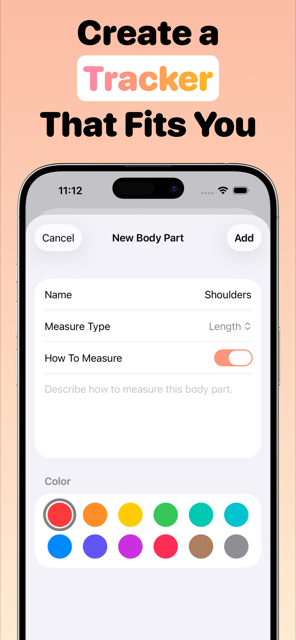
The Body Measurement Tracker app is built for exactly this method: biceps and thighs tracked left/right separately, 30-day and all-time trends per body part, interactive charts, and goals for the numbers you're chasing. Shoulders aren't in the default list? Add a custom body part in seconds — with your own how-to-measure note so you use the same landmark every time. A weekly reminder keeps the ritual alive.


The habit that makes it work
Muscle growth rewards patience, and so does measuring it. Log your numbers every 2–4 weeks, judge nothing on a single reading, and re-read the chart every couple of months. For the full reasoning on cadence, see how often to take body measurements.